
Rafting


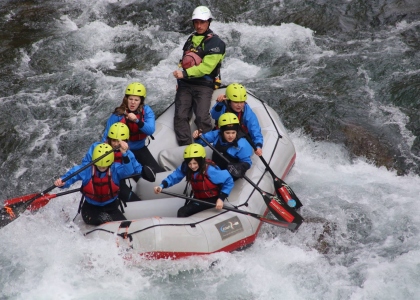
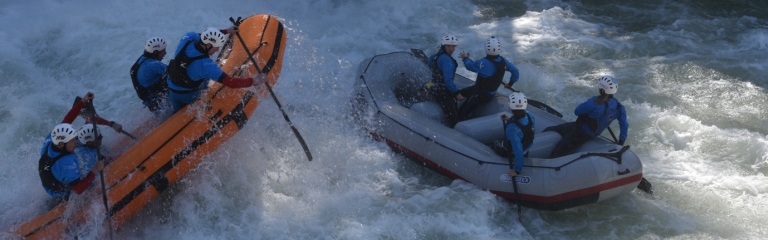
What is rafting?
Competition takes place across two main disciplines: slalom, where teams navigate through a series of suspended gates on a technical course, and downriver (or sprint), where crews race head-to-head or against the clock over a set distance on open white water.
Slalom
Slalom racing is a thrilling test of speed, precision and teamwork. Teams must navigate a course of suspended pole gates in strict numerical order, racing against the clock across two runs — with only their best time counting toward the final result.
The course presents a series of challenges designed to push crews to their limits. Green-and-white gates must be taken with the current, while the more demanding red-and-white gates require teams to drive their raft upstream against the flow. Each course features between 8 and 14 gates, with up to 6 upstream gates distributed across both banks of the river or channel — ensuring a balanced and unpredictable challenge.
Every gate must be conquered cleanly and in the correct sequence. Touching a pole or missing a gate entirely carries a heavy penalty, meaning that raw speed alone is never enough. The fastest teams are those who combine explosive power with razor-sharp technique and flawless communication — making every run a breathtaking blend of athleticism and strategy.
Downriver
Downriver racing is a pure test of power, endurance and river-reading skill. Teams charge downstream along a pre-set course, battling the river's natural obstacles and technical challenges as they chase the fastest time possible.
Courses stretch between 3,000 and 7,000 metres, taking crews through demanding whitewater terrain imaginable. The team that best combines raw speed with smart navigation will always have the edge.
But downriver racing is not just about who paddles hardest. Clean racing is essential. Any intentional physical contact - whether paddle on paddle, or crew on crew - is strictly prohibited and punished with a 10-second time penalty added to the overall race time, with multiple infringements accumulating and potentially leading to outright disqualification. In a sport where races can be decided by fractions of a second, a single moment of reckless racing can cost a team everything.
History of rafting
Rafting was imported into Europe by the French Aventure Nouvelle in 1984 and it quickly started to spread in the continent, the first competitions were organised in France in 1984.
In 198,9 the American and Russian foundation Peace Found, in the context of several charity and educational projects, organised “Project Raft”, the first international rafting event. The goal of Project Raft was to develop the relations between the two Nations as, even then, rafting was considered an aggregating and inclusive activity.
The first Project Raft “competition” took place in Siberia (Russia) on the Chuya River; in the following years it was organized in North Carolina (USA) on the Nantahala River. The Project didn’t end there but it further developed into a series of international championships around the world.
More about United Rafting
The World Rafting Federation (WRF) and the International Rafting Federation (IRF) came together in April 2026 to create a single governing body for the sport, called United Rafting.
The ICF and WRF signed signed an agreement in April 2018 to work together to jointly promote their activities.
United Rafting is the final authority for all matters concerning competition rafting and licensing of WRF River Guides.
United Rafting General Board
● President: Danilo Barmaz (Italy)
● Treasurer: Blerina Ago (Albania)
● Board Member: William Kariuki Mwangi (Kenya)
● Board Member: Hadi Seyed Ghaziasgar (Iran)
● Board Member: Gurkan Kose (Turkiye)
● Board Member: Boris Purjakov (Serbia)